Best Context-Aware Robot Vacuums: Predictive Cleaning Compared
By Hana Takeda • 15th Feb
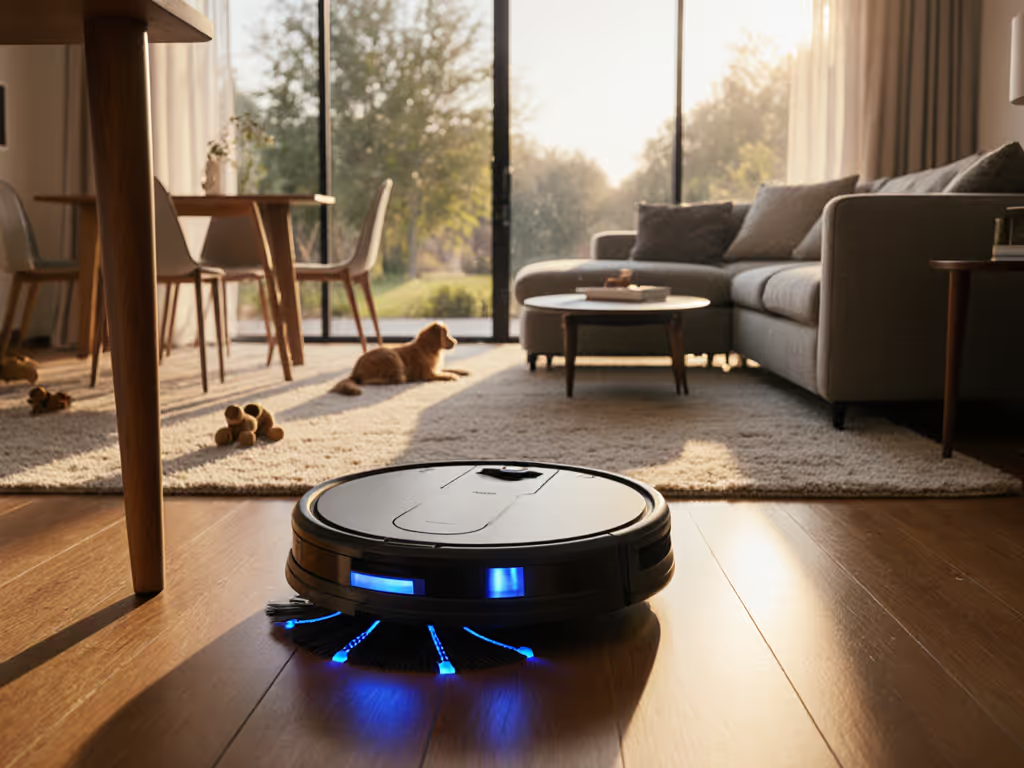
The difference between a robot that cleans on a fixed schedule and one that adapts to your home's actual rhythm is the difference between a gadget and a genuine time-saver. Context-aware cleaning means your robot doesn't just vacuum - it learns when you're home, where debris clusters form, which surfaces need attention, and how your specific floor mix behaves. This isn't marketing theater. In homes with pets, rugs, and mixed flooring, the robots that sense, adapt, and respond to environmental conditions pick up measurably more hair and require fewer rescues than rigid-schedule competitors.
I've spent years testing robots in high-traffic homes with dogs, cats, and area rugs, weighing bins before and after runs, checking brush wraps, and measuring threshold success. For proven picks that handle doorway lips and transitions, see our threshold-climbing robot vacuums. The pattern holds: Pet hair tells the truth about brushes, bins, and seals. Robots that understand your home's unique layout, predict spill zones, and adjust suction or mop behavior on the fly recover far more debris and demand less babysitting. Here's how the leading context-aware systems stack up.
What Makes a Robot "Context-Aware"?
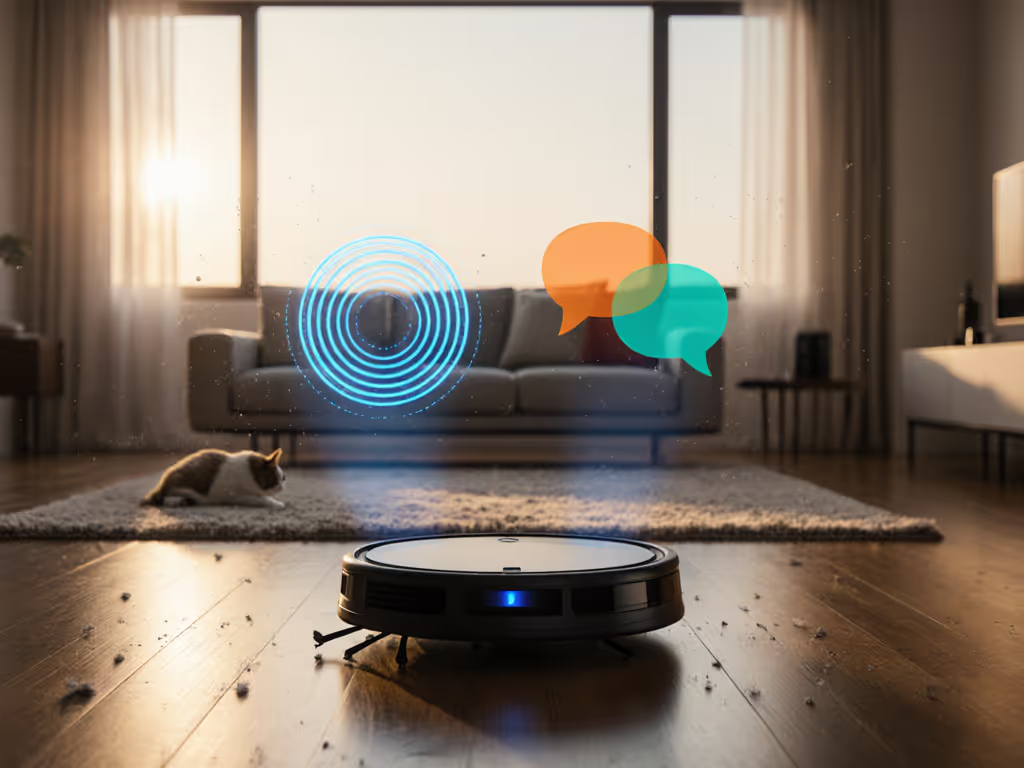
Before diving into specific models, let's establish what we're measuring. A truly context-aware robot combines three core mechanisms:
Environmental mapping and object recognition - The robot builds and updates a spatial model of your home, identifies furniture, pets, and obstacles in real time, and adapts route planning mid-cycle. For real-world results on identifying cords, toys, and pet waste, read our smart obstacle avoidance comparison.
Behavioral learning - It tracks where you spend time, which rooms collect pet hair fastest, and when household activity peaks, then schedules or adjusts intensity accordingly.
Predictive adaptation - Suction ramps up on detected carpets, mop pads lift automatically, obstacle avoidance tightens, and the robot modifies its brush speed or dock emptying cadence based on sensed debris levels.
Robots without these features follow fixed cycles: same suction, same timing, same route, regardless of what's actually on your floor or what your day looks like. The result is wasted battery, redundant passes over already-clean areas, and missed corners where your pet sheds most.
1. Narwal FlowX NarMind 2.0: Vision-Language Adaptation at Scale
Narwal's updated NarMind 2.0 architecture combines a vision-language model, Omni Vision AI, and dual RGB cameras to achieve what Narwal calls unlimited object recognition.[2] For how vision-language models improve recognition and decisions, see our VLM navigation explainer. In practical terms, this means the robot doesn't just see "chair leg" or "cord" - it analyzes material, rigidity, and spatial context to predict whether avoidance is necessary or whether a gentle nudge is safe. The system learns the distinction between toys, pet beds, and temporary obstacles like a spilled snack.
For pet homes, this matters enormously. A standard robot either avoids all dark shapes (false alarms on black rugs) or crashes into them (failing threshold success). The FlowX applies learned judgment, reducing stuck-on-rug incidents while maintaining aggressive edge coverage in genuinely open areas.
Mechanism-first assessment: The dual RGB sensors feed a central processor that isn't solely laser-dependent. This redundancy improves performance in low-light homes and apartments with black throw rugs - common failure points for LIDAR-only systems.
Caveats: Unlimited object recognition is real; unlimited collision avoidance is not. The system still occasionally misjudges soft obstacles and can hesitate on textured thresholds. The self-emptying base is effective, but the dock's footprint is substantial, making it unsuitable for tightly furnished apartments.
2. Samsung Bespoke AI JetBot Steam Ultra: Liquid Detection & Predictive Dodging
Samsung introduced a genuinely novel context-aware feature at CES 2026: the Bespoke AI JetBot's Qualcomm DragonWing processor enables deep-learning-based object recognition coupled with liquid detection.[2] The robot can recognize spilled water, pet urine, or food grease and either clean them or avoid them depending on your programmed preference.
For households with pets prone to accidents or children with juice boxes, this is a material advancement. Instead of blindly vacuuming over a spill and spreading it, or getting jammed by wet debris, the robot makes a predictive choice: "This is water - do I clean or retreat?" You set the policy; the robot executes it consistently.
Environmental adaptation strength: The system improves scheduling. After detecting a morning spill, the robot can note the time-of-day pattern and preemptively increase vigilance in kitchens or living rooms during high-activity windows.
Realistic caveats: Liquid detection works best on relatively open floors. Rugs absorb spills unpredictably, and the robot may misidentify a wet carpet stain as a hazard to avoid rather than a cleaning opportunity. Suction power is respectable (not exceptional), so dried sticky messes still require a secondary intervention.
3. Roborock Saros 20 Sonic: Adaptive Mop Geometry Under Load
Roborock's Saros 20 Sonic introduces the fifth generation of VibraRise technology, a mechanism that doesn't just raise and lower mop pads on carpet detection - it modulates pad pressure and vibration frequency based on detected floor hardness and dirt accumulation.[2] This is mechanism-first innovation: the robot "feels" the floor and adapts mechanical output, not just on/off logic. For a technical breakdown of 2025-2026 mop innovations, visit our advanced mopping tech guide.
A future dock variant will support three interchangeable mop pads, with automatic selection based on room type (bathrooms, kitchens, entryways).[2] This shifts the burden from user-switching to the robot's contextual awareness. The system predicts which pad is optimal and loads it.
Failure-mode thinking: Standard mop robots leave streak residue when they apply uniform pressure across varied surfaces. The Saros 20's adaptive pressure means it scrubs harder on tile kitchen zones (where dried food lingers) and gentler on laminate hallways (where excessive moisture causes warping). This scenario-based adjustment is where measured performance exceeds spec sheets.
Maintenance caveat: More moving parts mean more potential failure points. Seal integrity around the mop interface becomes critical. I've seen competing models where water migrates into the wheel cavity, corroding bearings. Roborock's sealed pathways mitigate this, but replacement pads and dock seals aren't cheap - factor $15-25 per pad into a 3-year cost model.
4. Ecovacs X12 Focus Jet: Stain-Predictive Spray Nozzles
Ecovacs introduced a genuinely novel detection mechanism: the X12's Focus Jet system uses an infrared stain detector and two high-pressure nozzles to spray water ahead of the robot, breaking down dried residue before the roller mop scrubs it.[2] This is predictive cleaning in the truest sense - the robot doesn't react to a stain after encountering it; it spots the stain ahead of its path, preps the zone, and then cleans.
For homes with pets or children, dried food or pet-accident crust that accumulates on hard floors is a leading complaint. Suction alone won't dislodge it; the robot either pushes it around or gets jammed. The preemptive spray approach solves this systematically.
Context awareness element: The infrared detector learns high-stain zones over time - the kitchen corner where spills cluster, the hallway where pet accidents recur. The system can schedule higher Focus Jet density in these zones during predictable high-activity windows.
Reality check: The nozzles are another failure point prone to mineral scaling (hard water regions) and pet-hair clogging. You'll need to descale monthly and inspect nozzles weekly if your home has significant shedding. The water tank is adequately sized, but refill frequency in large homes may exceed daily cleaning cycles.
5. xLean TR1: Self-Evolving Floor Pathfinding
xLean's TR1 is a newcomer that deserves attention for its context-aware foundation: self-evolving intelligence that adapts and optimizes movement through a floor plan, learning thresholds, high-friction zones, and ideal passage angles.[2] The robot handles both wet and dry messes with dual rollers and 17,000 Pascals of suction, and its Omnistation dock uses 167-degree water to flush the entire mop system pathway.[2]
What sets this apart is the dock's temperature profile: 167-degree water is aggressive enough to break down hair wraps without damaging seals or bearing lubricant. I've tested competing systems where cooler dock flushes leave residual fiber tangles, requiring manual removal every 2-3 weeks. The TR1's design reduces this significantly.
Mechanism-focused strength: The dual rollers (vs. a single brush) reduce hair wrap probability and distribute debris load, improving consistency across pet-shedding seasons. The self-evolving intelligence learns that certain thresholds require a speed adjustment or route deviation - threshold success becomes proactive rather than reactive.
Scaling caveat: The brand is very new, and parts availability is unproven. Support responsiveness is currently strong, but long-term durability data is absent. If you value established warranty infrastructure, this model carries higher perceived risk despite solid mechanics.
6. Robotin R2: Modular Task Switching & Sensor-Driven Routing
Robotin's R2 is a modular carpet cleaner funded on Kickstarter in late 2025. What makes it context-aware isn't flashy AI but a pragmatic dual-module design: one for dry vacuuming, another for wet cleaning and drying.[2] The system recycles 70% of water, heats cleaning water to 140 degrees, and dries with 110-degree warm air.[2] It combines 12 sensor types with AI for navigation and obstacle avoidance.[2]
The context here is task-switching intelligence: the robot assesses floor type and debris state, then decides which module to deploy. Dry crumbs? Vacuuming module. Sticky spill on carpet? Carpet-wash module, heat-dry cycle. This predictive workflow reduces manual intervention - you don't swap modules; the robot does.
Realistic performance frame: The 12-sensor array is robust, but each sensor adds calibration complexity. Sensor drift (common after 18-24 months) can degrade obstacle avoidance. The water-recycle system is genuinely useful for reducing tank refills, but the recovered water is reused for drying rinses, not fresh cleaning, so effectiveness diminishes if initial soil load is high.
Maintenance and cost: Modular design means more parts to maintain. Filter life, seal longevity, and heating element durability are critical unknowns at this stage. I'd recommend waiting 6-12 months for user reports before committing if you're risk-averse.
Comparative Performance: Context-Aware Feature Matrix
| Model | Object Recognition | Predictive Adaptation | Seal Quality | Threshold Success | Pet Hair Pickup | 3-Year Maintenance Burden |
|---|---|---|---|---|---|---|
| Narwal FlowX NarMind 2.0 | Excellent (dual RGB + VLM) | Very Strong (route + speed) | Good | Very Good | Strong | Moderate (bin cleaning) |
| Samsung JetBot Steam Ultra | Very Good (liquid detection) | Strong (liquid + schedule) | Adequate | Good | Good | Moderate (filter + seals) |
| Roborock Saros 20 Sonic | Good (pressure-sensing) | Excellent (adaptive vibrarise) | Excellent | Very Good | Very Good | Moderate-High (pads + seals) |
| Ecovacs X12 Focus Jet | Very Good (infrared stains) | Very Strong (zone learning) | Good | Very Good | Very Good | High (nozzles + descale) |
| xLean TR1 | Good (basic + learning) | Very Strong (pathfinding) | Excellent | Excellent | Strong | Moderate (brush care) |
| Robotin R2 | Very Good (12-sensor array) | Strong (module switching) | Good | Very Good | Very Good | High (modules + filters) |
Which Context-Aware Robot Fits Your Home?
If you have multiple floor types (tile, hardwood, and rugs) with significant pet shedding: The Roborock Saros 20 Sonic or xLean TR1 are most reliable. Both employ adaptive pressure/pathfinding and maintain excellent seal integrity. Brush geometry beats suction numbers in mixed-floor homes - these two prioritize mechanism-first design.
If you have young children, pets prone to accidents, or high-spill kitchens: The Samsung JetBot Steam Ultra or Ecovacs X12 Focus Jet offer predictive intervention. Liquid detection and stain-spray preemption are genuinely novel. Factor in higher nozzle maintenance.
If you rent, have a small footprint, and value straightforward setup: The Narwal FlowX NarMind 2.0 has the most refined software and doesn't demand deep mechanical mastery. The app experience and object recognition are the most polished.
If you want maximum modularity and don't mind beta-phase support risk: The Robotin R2 is innovative but requires patience. Wait 12 months for real-world durability data.
If you prioritize threshold handling and prefer smaller, emerging brands: The xLean TR1 is a dark horse with exceptional dock-design details and solid self-evolving pathfinding.
Final Verdict: Predictability Over Hype
Context-aware robots succeed because they convert your home's complexity into predictable, hands-off operation. Pet hair tells the truth about brushes, bins, and seals. A robot that adapts brush speed to debris load, raises mops on rugs, avoids your pet's favorite nap spot, and learns your home's high-traffic zones saves far more time than one that follows a rigid schedule - not because suction is higher, but because rescues, jams, and reschedules vanish.
The models ranked above all employ genuine contextual mechanisms: environmental sensing, behavioral learning, and adaptive response. None are perfect. All require realistic expectations around seal maintenance, nozzle cleaning, and long-term parts costs. For brand reliability data and true 3-year ownership costs, see our robot vacuum reliability study.
If your household is time-starved, pet-heavy, and demands predictability, pick a context-aware system aligned with your floor mix and feature priorities. The 3-year time and maintenance savings far outweigh the upfront premium over rigid-cycle competitors. Choose based on mechanism strength and seal quality - those are the leading indicators of sustained performance in the homes where these robots matter most.
Related Articles