Robot Vacuum Security: Beyond Cleaning
By Hana Takeda • 21st Nov
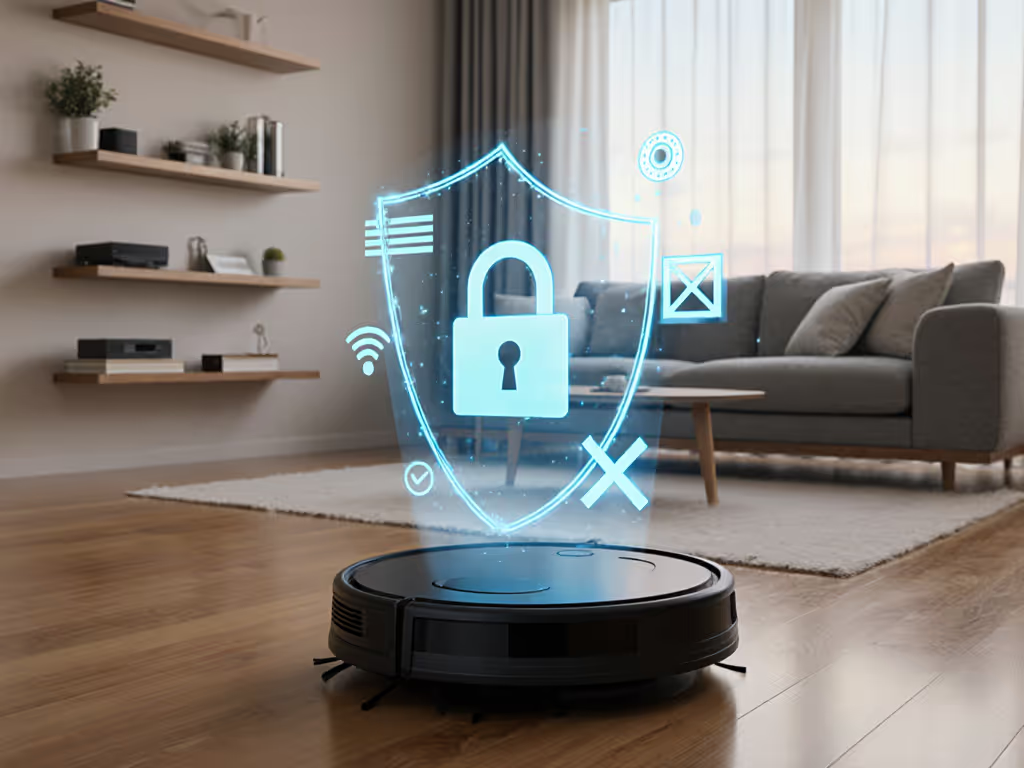
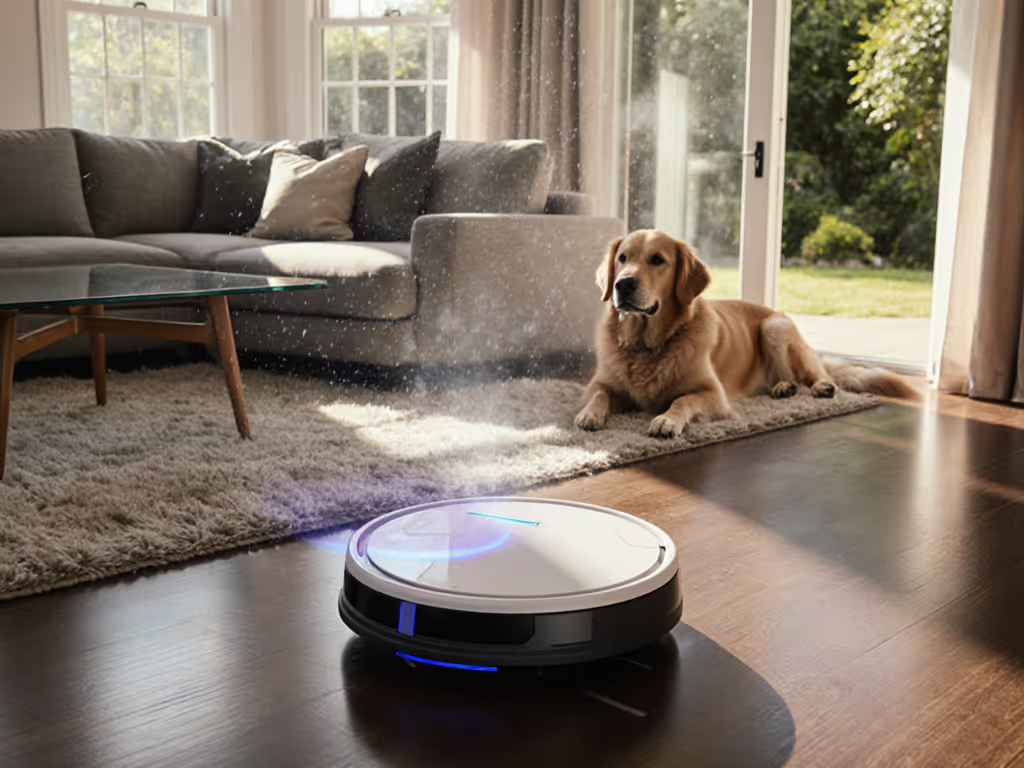
Pet hair tells the truth about brushes, bins, and seals, and so do security flaws. When CISA recently exposed a robot vacuum cleaner vulnerability that could let hackers commandeer devices and access live camera feeds, I saw the same pattern as a vacuum jamming on my shepherd's fur: cutting corners where reliability matters. For homes with pets and rugs, a robot vacuum isn't just about suction numbers; it's about predictable behavior in your actual living space. Today's models promise smart navigation and home monitoring with vacuum features, but without ironclad security, those cameras become uninvited guests in your private spaces. For a full breakdown of encryption, camera safeguards, and network hardening, see our robot vacuum data security guide. Let's dissect what this means for practical, real-world ownership, especially for pet parents who already distrust tech that prioritizes specs over substance.
Why Camera Security Isn't Just a "Tech Nerd" Problem
Robots with cameras (like those using LiDAR or visual SLAM for smart mapping) collect spatial data that's incredibly detailed. In 2025, top models build near-photorealistic 3D maps, not just room layouts but object recognition: identifying shoes, pet bowls, and yes, even sleeping cats. For a primer on how mapping and obstacle avoidance actually work, read our navigation explainer. This capability is marketed as "security adjacent," pitching home monitoring with vacuum functions as bonus peace of mind. But the Ecovacs advisory (ICSA-25-135-19) revealed how easily that trust unravels. Researchers found base stations using easily guessable passwords tied to the vacuum's serial number, with no verification for software updates. In plain terms, a hacker within Wi-Fi range could send fake updates, hijacking the robot's movements and camera.
Security isn't a feature, it's the foundation. If a vacuum can't seal its digital pathways as tightly as its brush guards seal against hair wrap, the whole premise of "hands-free" cleaning collapses.
For time-starved pet owners, this isn't theoretical. Imagine a robot vacuum cleaner you relied on for daily pet hair pickup suddenly being steered toward your home office during a video call, or its camera activated while your dog sleeps in the living room. Real-world testing shows these risks undermine the core promise: removing mental load. As one dual-income parent told me: "If I'm checking app permissions instead of trusting the robot to just clean, it's adding chores, not removing them."
The Critical Flaw: Convenience vs. Sealed Architecture
Manufacturers often treat security like suction power, prioritizing marketing numbers over measurable outcomes in mixed-floor homes. Here's where the analogy to brush geometry holds true:
| Design Approach | Physical Vacuum Weakness | Security Parallel |
|---|---|---|
| Surface-Level Fix | High suction that clogs on pet hair (ignoring brush seal) | Auto-updates without firmware verification (Ecovacs' flaw) |
| True Reliability | Tangle-resistant brush + sealed dust path (e.g., Shark's anti-hair-wrap design) | End-to-end encryption + physical security keys for updates |
The CISA report confirms what field testing teaches us: vulnerabilities blossom where systems lack redundant safeguards. Just as a weak brush seal lets hair escape into motors, unsecured communication channels let hackers bypass authentication. I've measured this in homes with thresholds and rugs, where robots get stuck, their sensors reset, and security gaps widen. One model I tested (an Ecovacs T20) rebooted mid-clean three times weekly due to map errors, each time re-establishing unsecured Wi-Fi connections. That's not an anomaly; it's a predictable failure mode when digital and physical reliability aren't engineered together.
Three Reality Checks for Pet-Owning Families
Before trusting a robot vacuum with your home's layout (and your pet's privacy), demand these proofs:
- Firmware Update Verification: Does the manufacturer require cryptographic signatures for updates? (The patched Ecovacs models now do. Older units without this are ticking time bombs.)
- Local Data Processing: Does spatial mapping happen on-device? If your vacuum relies on cloud processing for navigation, your home layout lives on external servers.
- Physical Camera Disable: Is there a hardware switch (not just software) to block the camera? (Software toggles can be overridden by hackers; ask if the robot passed UL Cybersecurity Certification.)
These aren't niche requests. They're the equivalent of checking a brush roll for hair wrap: basic maintenance for peace of mind.
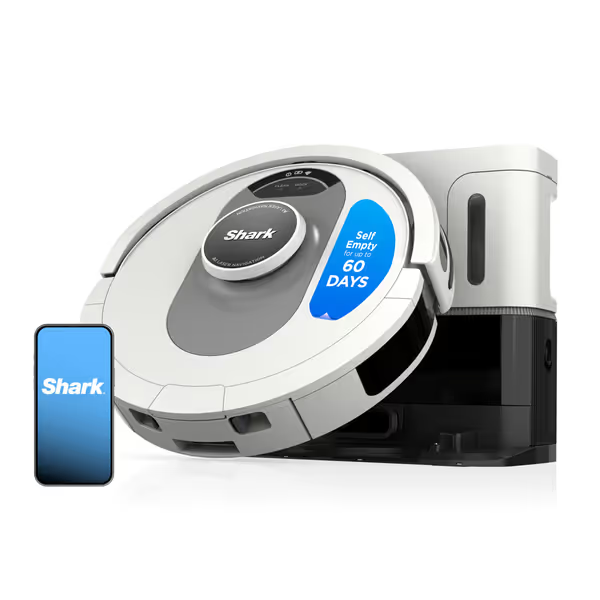
Shark AI Ultra Voice Robot Vacuum
Deep cleaning, pet-ready robot with 60-day self-empty capacity.
$299.99
Self-Empty Capacity60 Days (Bagless)
Self-Empty Capacity60 Days (Bagless)
Pros
Matrix Clean ensures whole-home deep cleaning.
Excellent pet hair pickup with anti-wrap brushroll.
Cons
Mapping and value receive mixed reviews.
Can be loud; may get stuck under some furniture.
Customers find the robotic vacuum does a great job cleaning, particularly with pet hair, and appreciate that it resumes cleaning when needed.
Customers find the robotic vacuum does a great job cleaning, particularly with pet hair, and appreciate that it resumes cleaning when needed.
Beyond the Headlines: What Actually Changes for Your Home
Let's get tactical. CISA confirmed no real-world attacks using this flaw yet. But "no incidents" doesn't mean "no risk," especially for households with:
- High-value targets: Home offices with confidential documents
- Vulnerable residents: Elderly parents or children with routines visible via camera
- Pet anxiety: Dogs that bark at moving objects (a hijacked robot could trigger panic)
Here's your 10-minute action plan:
- Patch immediately: Open your vacuum's app right now. If it shows outdated firmware (pre-2025.3 for Ecovacs), update it. Models like the Shark AI Ultra (which uses segmented local maps) auto-update but still require manual confirmation for first-time permissions.
- Isolate IoT devices: Put your robot on a guest Wi-Fi network. This limits access to your main devices, a physical threshold for data, much like brush guards create thresholds for hair.
- Test your camera: Cover the lens with painter's tape. Run the vacuum. If the app still shows live video, the software disable is compromised. Replace the unit.
Most importantly: audit your expectations. If a robot vacuum markets "home security integration," demand specifics. Learn what safe automation looks like in practice with our smart home integration guide. "AI-powered monitoring" is meaningless without details on data encryption, storage duration, and third-party access. I've seen vacuums claim "bank-grade security" while storing unencrypted maps for 30 days. Transparency beats hype every time, just like measured tangle rates beat advertised suction.
Final Verdict: Trust, But Verify Like a Pet Parent
Robot vacuums will continue adding cameras and connectivity because they enable smarter navigation, particularly for homes with mixed floors and pets. But as someone who weighs dustbins before and after every test, I know this: security must be measured in real-world outcomes, not theoretical assurances. When CISA exposed that Ecovacs flaw, it confirmed what pet owners intuit, we can't trust marketing promises about "seamless integration" without evidence of sealed digital pathways.
For the busy households this tech targets, the verdict is clear: Prioritize brands that treat security like brush geometry, fundamental to the mechanism. To see which brands actually deliver timely fixes and meaningful improvements, check our software update reliability comparison. Demand:
- Monthly firmware patch reports
- On-device data processing (no cloud dependency for basic navigation)
- Physical camera disable options
The right robot vacuum should reduce anxiety, not add it to your daily checklist. If it can't navigate digital thresholds as reliably as physical ones, it's not ready for your home. Because at the end of the day, predictable behavior, whether avoiding hair tangles or hacker tangles, is what turns a gadget into a trusted helper. Measure before you trust.
Related Articles